.svg)


.svg)
.svg)


As Phase Two of MRT Putrajaya Line is being geared towards operations, aside from the required testing and trial operations, the new alignment has to be tested on its safety aspects to ensure that it is safe, reliable and efficient come full operations. This was achieved through an Emergency Response Plan (ERP) exercise, conducted by the operator of the MRT, Rapid Rail Sdn. Bhd.
The ERP exercise, dubbed ‘BMXPERT 2023’ was held on 12 January 2023 at the Bandar Malaysia South MRT Station (BMSS), one of the five provisional stations for Putrajaya Line. This exercise is a mandatory requirement by the Land Public Transport Agency (APAD), before an operating license can be issued for Phase Two of MRT Putrajaya Line.
Present to witness the simulation exercise were MRT Corp Chief Executive Officer Datuk Mohd Zarif Hashim, Rapid Rail Chief Executive Officer Encik Amir Hamdan, MRT Corp Head of Standard & Compliance Encik Azhar Sofah and Prasarana Group Chief Health, Safety, Security, Environment & Sustainable Development Officer Encik Idzqandar Abu Bakar.
In this ERP exercise, a sequence of incidents tested the effectiveness of the operator’s ERP, as well as to measure the efficiency of the relevant government agencies namely the Polis DiRaja Malaysia (PDRM), Fire and Rescue Department (BOMBA), the Ministry of Health, Hospital Kuala Lumpur and the Department of Civil Defense (JPAM), in responding to such emergency situations.
During the exercise, a simulation of a major train incident took place, beginning with Train TR201 experiencing signalling problems at Kuchai Lama MRT Station, resulting in an emergency evacuation at Chan Sow Lin MRT Station North platform. During the evacuation process, a male trespasser hijacked the train and took hostage of the passengers and staff onboard. The Train Operator (TO) was forced at knifepoint to drive the train manually against the track direction. The Station Controller then alerted the Operation Control Centre (OCC) of the situation, upon which, the OCC notified the relevant authorities of the situation.
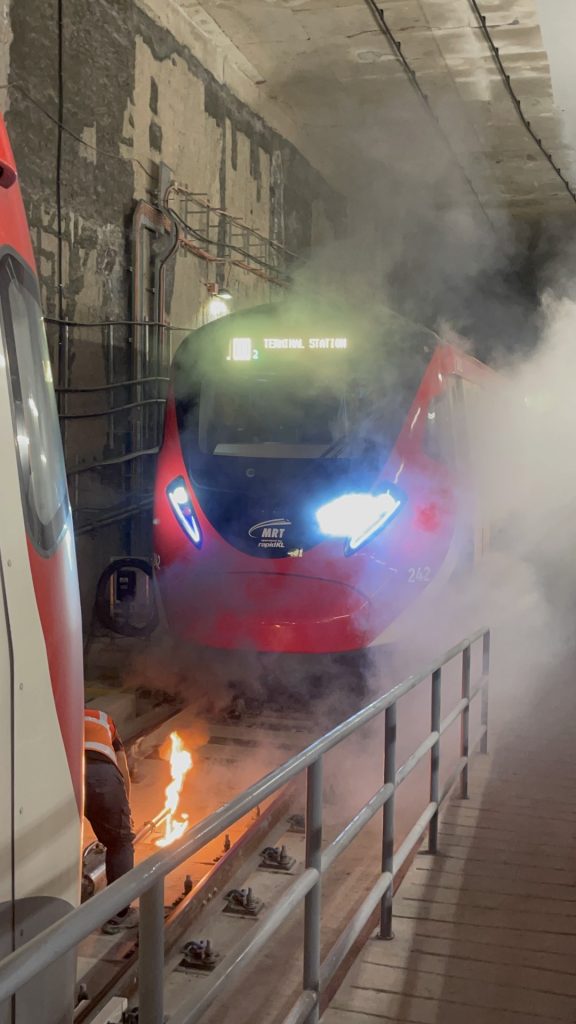
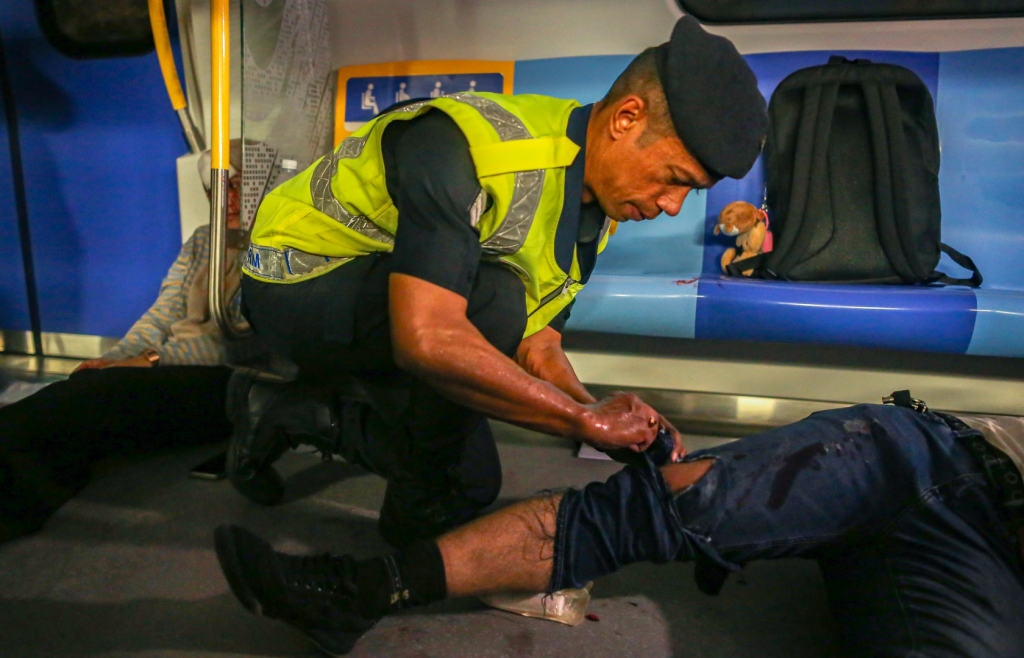
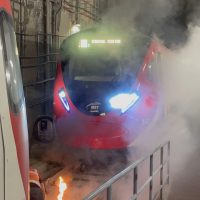
While train TR201 was moving through BMSS, it collided with train TR202 at the North Bound Crossover BMSS, which was carrying passengers from Putrajaya towards Kwasa Damansara. This resulted in the passengers, experiencing injury from the collision as well as train derailment and subsequently caught fire.
The OCC then verified the incident via the train CCTV and instructed the operations staff at Chan Sow Lin MRT Station and Kuchai MRT Station to head to the incident location to activate the necessary action.
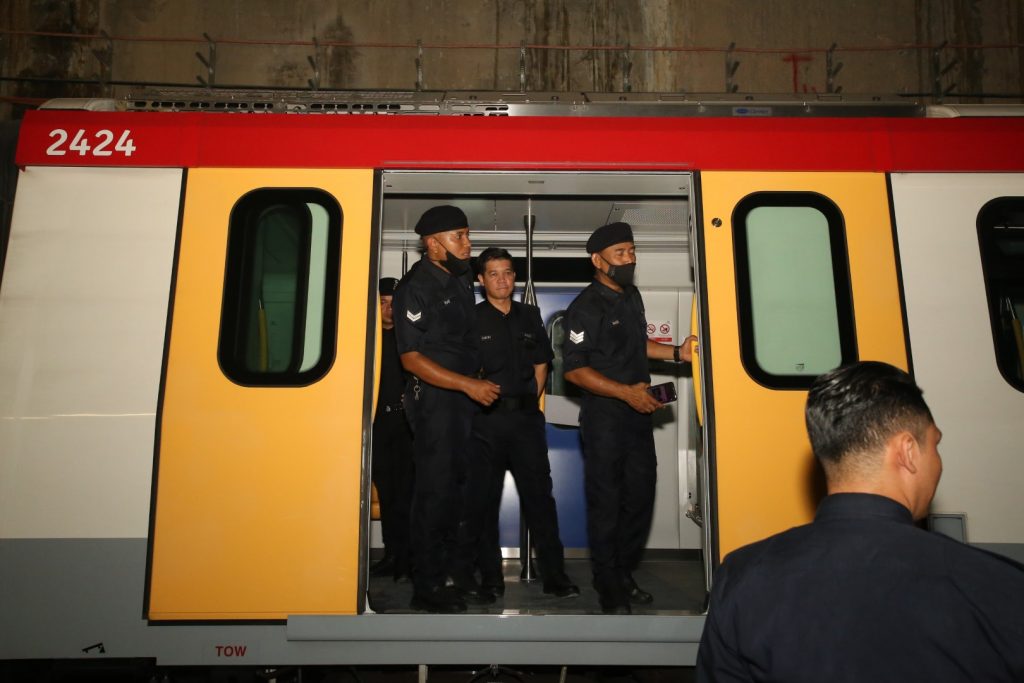
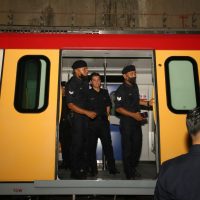
The authorities arrived at the scene and took control of the situation, with PDRM being the first to arrive at the incident location and immediately began tracking the perpetrator, while being assisted by the operations staff. A third rail earthing device was installed as a safety measure.
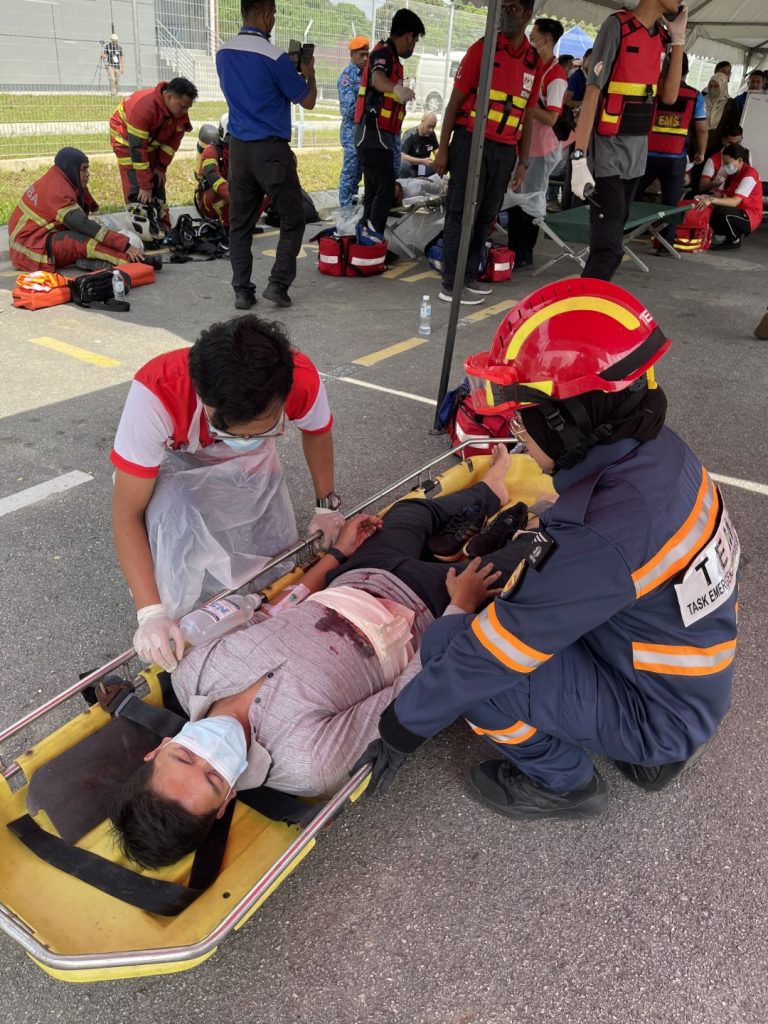
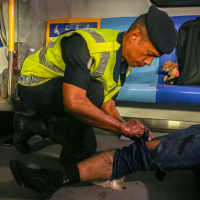
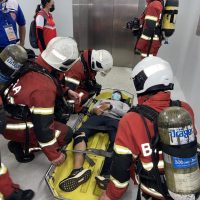
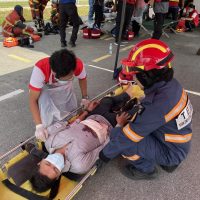
Upon PDRM’s greenlight, the rest of the government agencies involved began entering the incident site to begin the evacuation process, and to rescue and relieve the passengers and staff onboard the two trains. Passengers experiencing injury were brought to the triage area and were later sent to Hospital Kuala Lumpur for further treatment.
Once the situation has been stabilised, staff from the operator’s rail engineering department began carrying out investigation and recovery works to allow the line be reopened following the incident.
Through this exercise, the operator’s ERP was tested with tweaks made from the lessons learnt. The half-day ERP exercise was a success as all parties were able to execute their roles and responsibilities as planned.